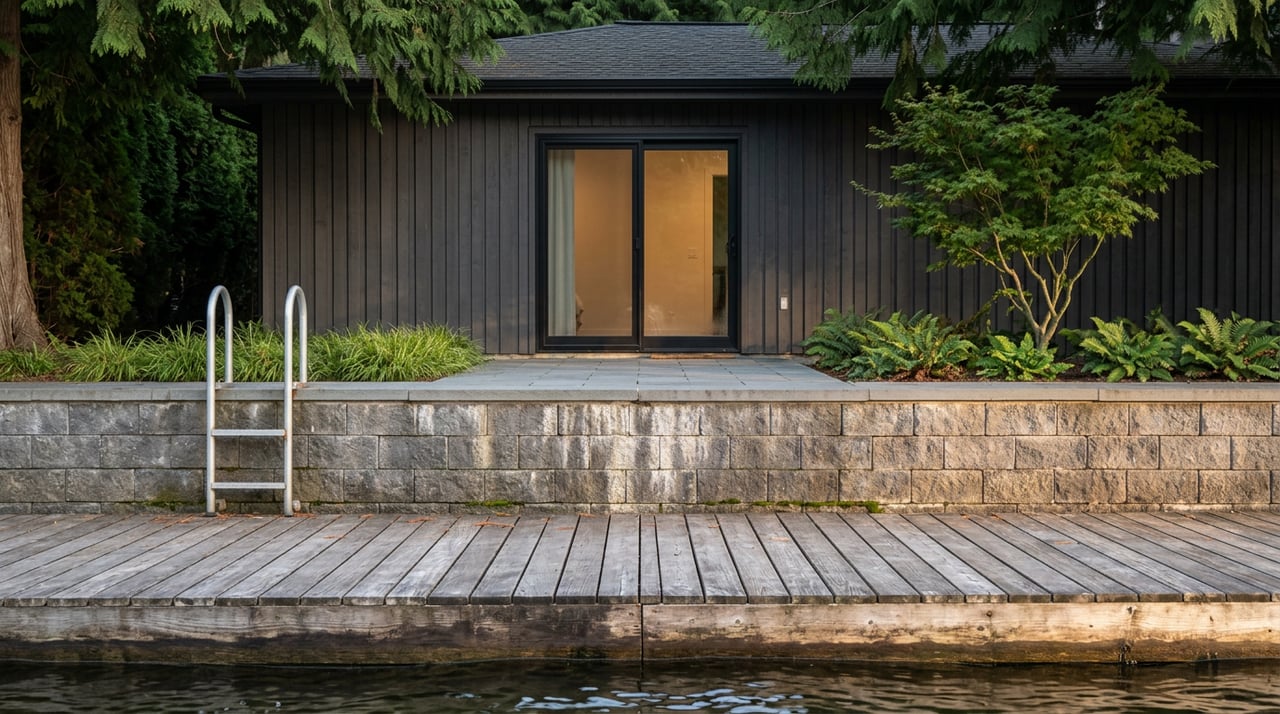
A shoreline permit filed with the City of Kirkland earlier this year for dock repair at Homeport Marina spells out, in flat bureaucratic language, exactly when a crew can and cannot touch the water. No trucking on site Saturdays. No inspections on Saturdays. Light grading only. No development activity or heavy equipment on Sundays, or on New Year's Day, Memorial Day, the Fourth of July, Labor Day, Thanksgiving, or Christmas. It reads like a building code for a much bigger project than it is, because in Kirkland's shoreline jurisdiction, it functionally is one.
That permit, filed by Jennifer Hagge of PMF Real Estate Services LLC with Waterfront Construction Inc. named as contractor, is a routine piece of the public record. It is also a useful corrective for anyone about to buy waterfront property here on the assumption that a dock is a dock, and that fixing one later is a weekend errand. It is not. And the rule that decides how much process you are in for is stranger than most buyers expect: it is not about what you are building, it is about what the work costs.
A Dock Is Not Automatically Part of the House
The first assumption worth checking before you write an offer is whether the home actually comes with private dock rights at all. On Lake Washington, that is never a given. A property might have a private dock, a shared arrangement with a neighbor, no water access structure whatsoever, or an older dock whose legal status has never been confirmed. Kirkland's zoning code also caps how much dock a lot can have in the first place: a single property is limited to one pier or dock, under the shoreline management chapter of Kirkland's zoning code. That cap matters when you're comparing two "waterfront" listings that look similar on paper but sit on opposite sides of that line, one with a legal dock in place and one where you'd be starting from zero.
Kirkland's Shoreline Master Program governs any of this within 200 feet of Lake Washington's ordinary high water mark, plus connected wetlands. That 200-foot band covers more of a typical waterfront lot than buyers expect, and it means the dock is rarely the only thing under review. Decks, grading changes, and bulkhead work in that same zone can trigger the same process.
The Number That Actually Decides Your Timeline
Here is the part that catches people off guard, because it is not a technical distinction, it is a financial one. Washington's general threshold for what counts as "substantial development" under the Shoreline Management Act is $8,504, a figure the state adjusts for inflation every five years, with the next adjustment due July 1, 2027. Below that dollar figure, many shoreline projects can proceed as exempt, with lighter review. Above it, you're typically looking at a full Shoreline Substantial Development Permit.
Residential docks get a specific carve-out from that general rule. If you're replacing an existing dock with one of equal or smaller size, the threshold jumps to $28,000 in fair market value, effective since August 2023. Under that number, in a jurisdiction like Kirkland with an updated shoreline program, the replacement can often move forward with an exemption rather than the full permit process.
| Project type | Threshold | What it means |
|---|---|---|
| General shoreline development | $8,504 | Above this, a full Substantial Development Permit is typically required |
| Residential dock replacement (same or smaller footprint) | $28,000 | Below this, the project may qualify for exemption rather than full permitting |
The part that trips people up is how "fair market value" gets calculated. It is not just materials. State rules define it as the full cost of hiring a contractor to do the job start to finish, including labor, equipment, transportation, and contractor overhead and profit, and it even counts donated or found labor and materials toward the total. Two contractors bidding the identical repair can land on different sides of that $28,000 line depending on how they scope the job, which means the number on your contractor's estimate does more than set your budget. It can determine whether your dock project takes weeks or months.
What the Paperwork Actually Looks Like
The Homeport Marina filing is a working example of what sits on the other side of that line. It named not just the applicant and contractor but a distribution list that included Washington's Department of Ecology Shoreline Permit Review office and Karen Walter, the Watersheds and Land Use Team Leader for the Muckleshoot Indian Tribe's Fisheries Division. Technical drawings for the repair came from a marine engineering firm, NW Dock & Pile. Even the exemption approval carried a shelf life: four years from the date it was granted, after which an incomplete project would need to start the process over.
A separate Kirkland dock permit record shows the same pattern at smaller scale: a filing to repair four existing piles on one dock and five on another, replacing the old decking with thru-flow grated decking, the kind of surface that lets light reach the water below and is now common in shoreline-sensitive repairs. Neither of these filings involved a new dock or a size increase. Both still moved through a review process with named agencies attached to it.
If your plan for a waterfront purchase includes "we'll deal with the dock after we close," this is what dealing with it actually involves. It is not a phone call to a handyman. It is a filing with a distribution list.
The Costs That Show Up After You Own It
Beyond permitting, waterfront ownership carries maintenance math that rarely shows up on a listing sheet. Bulkhead replacement runs roughly $500 to $1,500 per linear foot, so a lot with 75 feet of shoreline could face a repair bill anywhere from $37,500 to well over $100,000 if the bulkhead is failing. Docks have their own ongoing costs: a wooden dock typically needs annual inspection, staining or sealing every two to four years, and eventual board replacement, which adds up to roughly $1,000 to $3,000 a year in upkeep. Composite docks need less, generally $500 to $1,000 annually for cleaning and hardware checks, but they are not maintenance-free.
None of this is a reason to avoid Kirkland waterfront. It is a reason to ask for dock permit history, bulkhead condition, and any existing shoreline exemptions before your inspection contingency runs out, not after.
Public Access Is Not the Same as Private Rights
One more assumption worth checking: Kirkland's public shoreline infrastructure is genuinely good, and it is easy to mistake that for private access. Marina Park Dock and the 2nd Avenue South Dock together offer 82 uncovered moorage slips year-round, but that moorage is transient, not a long-term slip assignment tied to a nearby home. Juanita Beach Park has roughly 1,000 feet of Lake Washington shoreline and a seasonal swim area. Both are real amenities for anyone living nearby, but neither substitutes for a deeded dock right if boat storage is part of why you want waterfront in the first place.
That distinction also helps explain why Kirkland's waterfront pricing spreads so widely by pocket, from listings in the upper six figures in North Juanita to well into seven figures near Market, as of spring 2026 reporting. Some of that spread is square footage and finish level. Some of it is genuinely about which parcels carry clean, documented dock rights and which don't.
A Few Direct Questions
Does every waterfront listing in Kirkland include a private dock? No. Dock and moorage rights are specific to each property. Some homes have a private dock, some share access, and some have none at all or a structure with unclear legal standing. Confirm dock rights and permit history before closing, not after.
What actually separates an exempt shoreline project from one that needs a full permit? In large part, it comes down to fair market value as defined by the state. Below $8,504 for general shoreline work, or below $28,000 for a like-for-like dock replacement, many projects can qualify for exemption. Above those figures, or if the work changes the dock's size or location, a full Shoreline Substantial Development Permit, conditional use permit, or variance may be required.
How long does shoreline permitting in Kirkland typically take? It varies with the scope of the work and which outside agencies get pulled in, but filings that touch tribal fisheries consultation or state ecology review, like the Homeport Marina repair, involve more than a single city desk. Seasonal work-hour restrictions can add further delay if your contractor's schedule doesn't line up with the approved window.
Waterfront ownership on Lake Washington is still one of the more durable investments on the Eastside, and Kirkland's shoreline rules exist for reasons that protect the lake as much as the homes on it. The point of understanding the $28,000 line and the paperwork behind it isn't to talk yourself out of a purchase. It's to walk into escrow already knowing what you own, what you don't, and what it will take to change that.
If you're evaluating a Kirkland waterfront property and want a clear read on dock rights, permit history, or what a shoreline project would actually cost to complete, Brian Hawkins and Cyrus O'Bryant have handled these transactions on this exact stretch of shoreline. And if your waterfront purchase depends on selling a current home first, their team can also put together a free home valuation to help you plan both moves together.